Why a Robot Can Explain Your Kitchen Before It Can Clean It
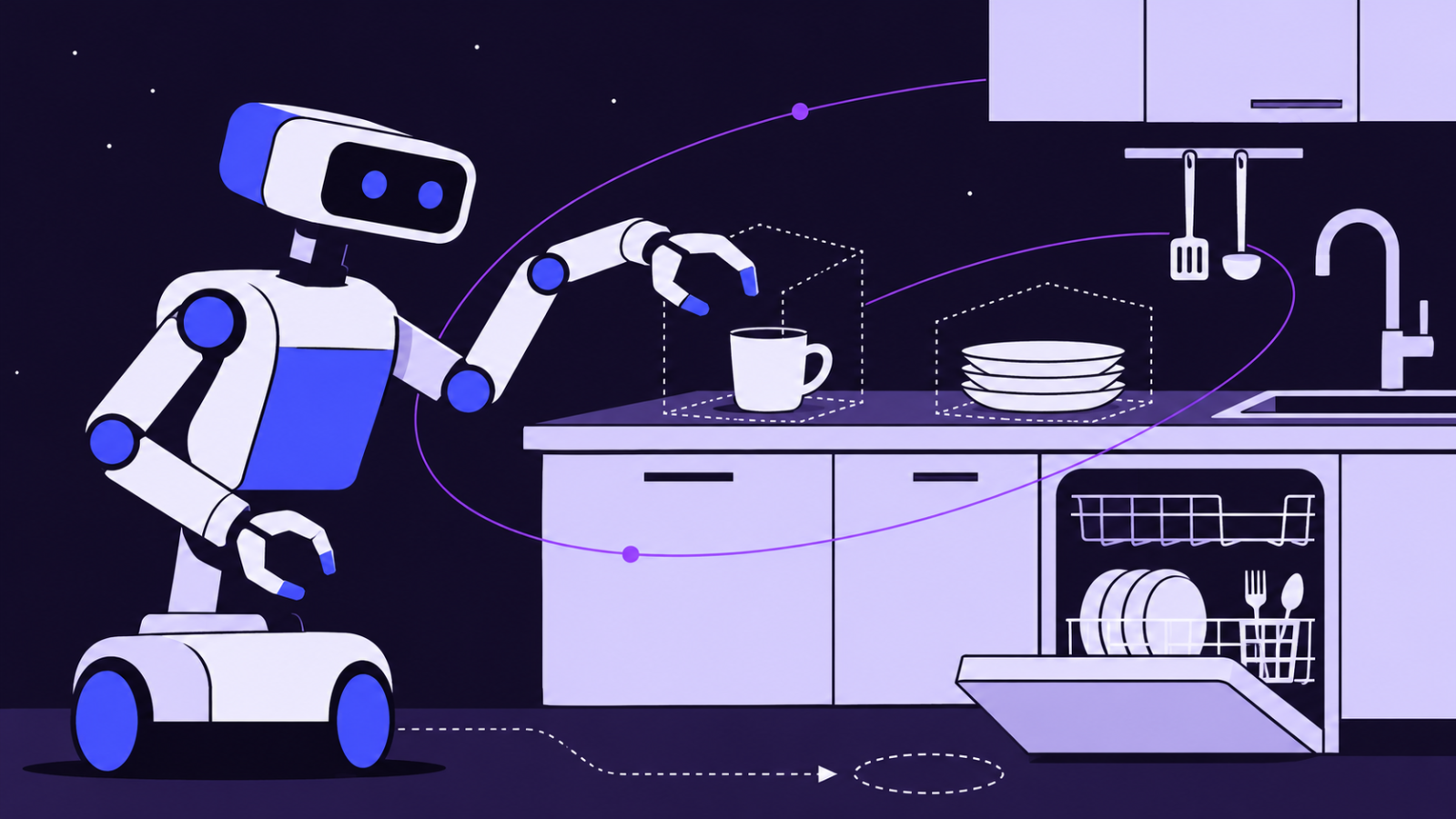
Ask an AI system how to clean a kitchen, and it can produce a sensible plan. It can distinguish washing dishes from wiping a counter, explain why raw meat requires particular care, and suggest an efficient order for the work.
Give a robot the same assignment, and the plan becomes the easy part.
A sponge deforms when squeezed. A plate partly conceals another plate. A cupboard door changes the space available for an arm to move. A mug that looks empty may contain liquid. Moving one object changes the scene the robot must interpret next.
The distance between describing an activity and reliably performing it helps explain why the progress of conversational AI has not translated straightforwardly into general-purpose robots. Language offers a compressed account of the world. Physical action requires dealing with the details that the account leaves out.
Research in robotics is increasingly organised around this gap. The question is whether machines can combine broad knowledge with the ability to act under conditions their designers did not arrange in advance.
What an instruction leaves unsaid
“Put the cup in the dishwasher” appears to specify a task. In practice, it depends on a collection of assumptions.
The dishwasher must be open or opened. The cup needs to be grasped without breaking it. Its contents may need attention. A suitable place must be identified, and the robot must release it in a stable position.
A person rarely articulates these steps. We draw on accumulated experience with weight, friction, balance, objects, and household conventions. We also continually adjust our movements using sensory information.
For a robot, knowing that cups belong in dishwashers does not determine the forces required to move this cup. Nor does recognising a handle establish whether it is reachable from the current position.
This distinction matters because impressive language or visual reasoning can make a system appear closer to physical competence than it is. A correct explanation of an action and a reliable controller for that action are separate achievements.
Bringing language and movement into the same model
One important research direction attempts to connect these abilities through vision-language-action models.
These systems use visual observations and instructions to generate actions. Their appeal is that a robot might draw on broad visual and linguistic knowledge instead of learning every task as an isolated routine.
Google DeepMind’s Gemini Robotics research, introduced in 2025, pursued this approach alongside a related model focused on embodied reasoning. The work explored capabilities including interpreting instructions, spatial understanding, and adapting actions to changing situations. The reported results belong to the researchers’ evaluation settings; they do not establish unrestricted competence in everyday environments.
The approach changes what researchers can ask of a robot. Rather than specifying every movement, they can investigate whether a model connects an unfamiliar instruction to previously learned physical skills.
But it also makes evaluation more complicated. A robot can recognise the correct object and still fail to grasp it. It can execute a movement accurately while misunderstanding the task. Success depends on several abilities working together.
The world does not provide ready-made robot experience
Language models benefited from enormous collections of existing text. Robot learning faces a different data problem.
A recording of someone opening a drawer shows what happened, but it does not directly provide the motor commands another machine needs. A robot’s reach, joints, gripper, and sensors affect how an action can be performed.
Experience collected on one machine is therefore not automatically usable by another.
The Open X-Embodiment collaboration addressed this problem by assembling data from 22 robot embodiments in standardised formats. Its research demonstrated that experience from different robots could, under the tested conditions, contribute to improved policies across platforms. The project provided evidence that robot learning need not remain entirely fragmented into separate machines and tasks.
The broader implication is significant. If physical experience can be shared effectively, each robot does not have to learn everything from the beginning.
Yet standardising a dataset does not make the bodies equivalent. A model still has to connect shared information to the possibilities and limitations of a particular machine.
A different kitchen is a different problem
A robot can perform well in a room it has repeatedly encountered, and struggle when the surroundings change. Researchers call the ability to carry useful skills into new conditions generalisation.
This is more demanding than recognising a new object. A different home introduces new layouts, storage conventions, lighting, obstacles, and combinations of familiar things.
Physical Intelligence’s π0.5 research, published in 2025, explicitly tested household tasks in homes absent from its training data. Its training approach combined robot demonstrations with other sources, including visual and language data. The researchers reported meaningful transfer to new environments while also documenting errors in both task interpretation and movement.
That combination of progress and failure is more informative than a successful demonstration alone.
Consider a robot that puts several items away correctly before choosing the wrong destination for another. Its movements may be adequate; its interpretation of the household may be wrong. Another robot might choose the right destination but repeatedly lose its grip.
These failures point towards different research problems. Treating them all as a single measure of “robot intelligence” hides what needs to be improved.
Can simulated experience make up the difference?
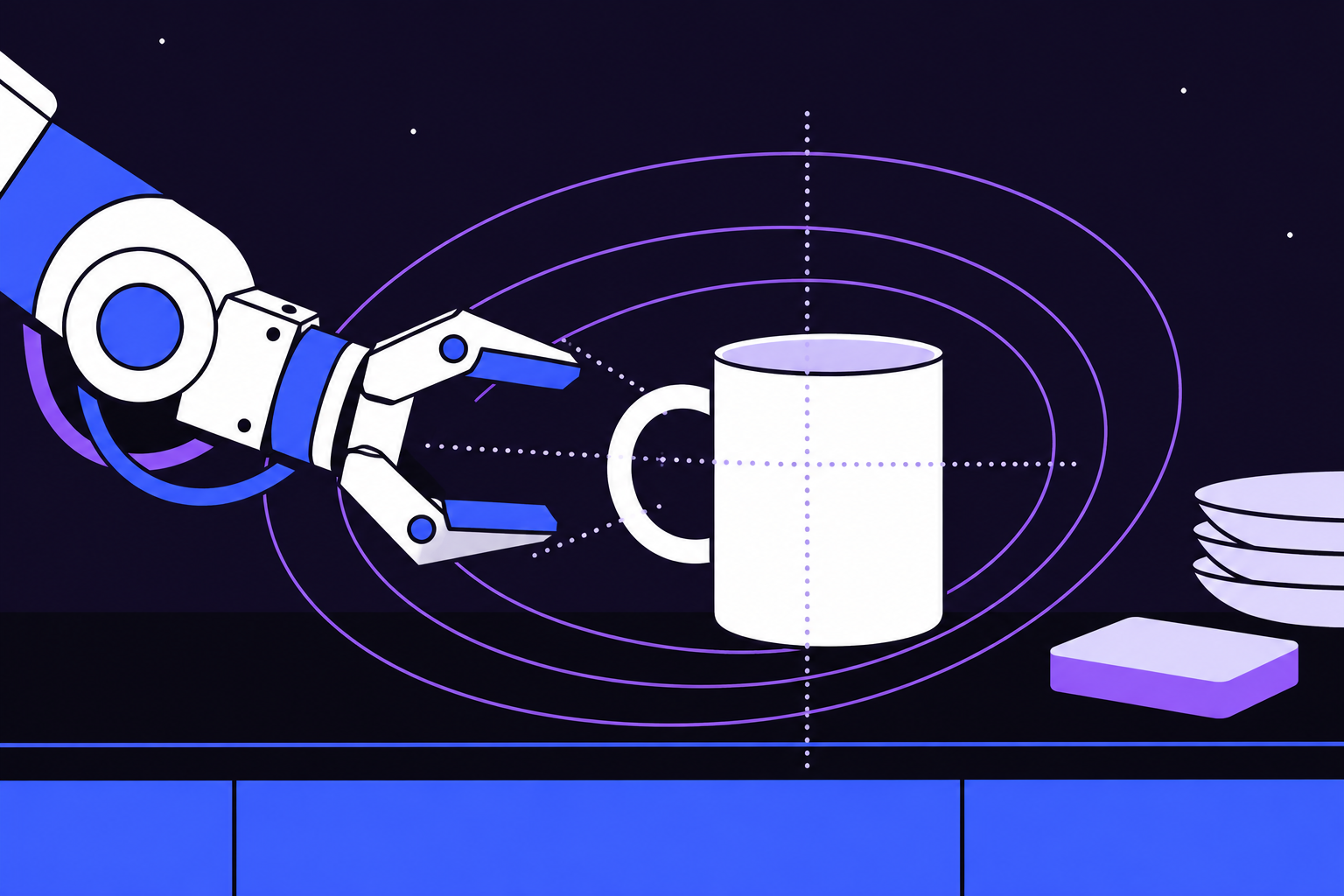
Collecting physical experience takes time. Hardware needs maintenance, objects must be reset, and some experiments carry a risk of damage.
Simulation offers a way to generate more experience without reproducing every attempt in a real room.
In the DexMimicGen project, researchers generated more than 20,000 demonstrations from 60 human source demonstrations across a set of manipulation tasks. The work illustrates how a small amount of human guidance can be expanded into a much larger training resource.
The remaining difficulty is whether the generated experience contains the details that matter outside the simulation. A controller may depend on assumptions about contact or object behaviour that hold in a virtual environment but fail on a physical machine.
Synthetic experience is valuable when the learned behaviour transfers. The number of generated examples, by itself, cannot establish that.
Reliability changes the meaning of success
Suppose a hypothetical robot succeeds at each of ten necessary steps with 95% probability. If the steps were independent and every one had to succeed, the chance of completing all ten would be about 60%.
Actual robotic tasks are more complicated: failures can be correlated, some mistakes are recoverable, and not every step has equal importance. The example nevertheless shows why a strong score on short actions may leave a long activity unreliable.
Recovery becomes part of competence.
A robot that notices a dropped object and safely tries again may be more useful than one that executes a perfect movement only under favourable conditions. A machine must also recognise when it cannot proceed: when an object is unknown, a person has entered the workspace, or an attempted action has changed the situation unexpectedly.
The next useful advance in robotics may therefore look less dramatic than a new acrobatic demonstration. It may be a machine working for an extended period in an unfamiliar setting, correcting ordinary mistakes and requesting help appropriately.
Cleaning a kitchen is a revealing test because it combines physical uncertainty with human expectations. Completing it reliably would require far more than knowing what a clean kitchen looks like. It would require learning how to make one, despite all the details that nobody remembered to specify.